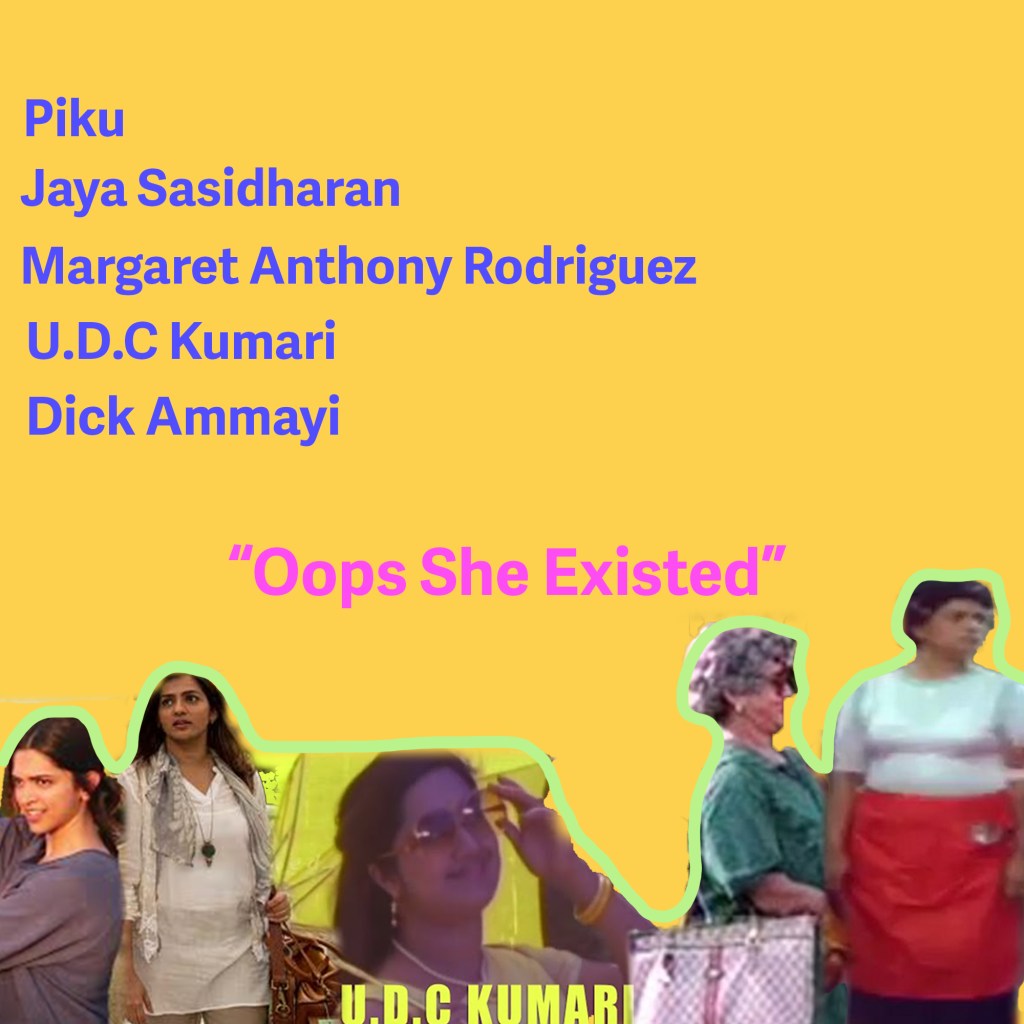
“Oops She Existed”

Female characters in Indian cinema have often been reduced to binaries: the good woman vs. the bad, the ideal vs. the irritating. But now and then, some characters manage to slip through. They don’t fit the mould neatly. They complicate, disrupt, or quietly question the roles assigned to them.

Piku from Piku (2015), Jaya Shashidaran from Qarib Qarib Single (2017), Dick Ammayi from Boeing Boeing (1985), UDC Kumari from Dr. Pashupathi (1990), and Maggi Aunty from Vandanam (1989).

What do these women have in common? On the surface, they belong to different genres, periods, and cultures. But look closely, and you’ll see they are all navigating a world that isn’t built for them, each in her own way, with a certain stubborn grace.

None of them were written as “feminist” characters. In fact, most were played for laughs or dismissed as side characters. But rewatch them today, and something shifts. Their small resistances, their sarcasm, their silence, they say a lot more than what’s on the page.

Dick Ammayi – Boeing Boeing (Sukumari)

Dick Ammayi is the household’s drill sergeant. In a film where the hero juggles three airhostess girlfriends, she’s the only one who knows what’s going on and doesn’t find it amusing. She manages the lies, the schedules, the mess,  and does it all while staying five steps ahead.

You can’t miss her outfit: a crisp white blouse, bright red apron, and black skirt. She looks like she’s running a military kitchen, not a bachelor’s house. It’s not about fashion, it’s about function, authority, and zero-nonsense.

She’s often the butt of jokes. Too strict. Too loud. Too “mannish.” But there’s power in the way she owns her space. She doesn’t ask for respect, she assumes it. And that, in the 1980s, was quietly radical.

UDC Kumari – Dr. Pashupathi (Kalpana)

Kumari, the Upper Division Clerk at the panchayat office, is hard to miss, with oversized sunglasses, sleeveless blouses, plain yellow chiffon sarees, and a voice that carries across rooms.

She gossips, dreams of romance, and doesn’t filter a single thought. She might seem silly, but she’s one of the few women on screen who is single, expressive, a little dramatic, and completely unapologetic.

Kumari isn’t polished, but she’s real. She doesn’t play it cool. And that’s exactly why she stays with you.

Maggi Aunty – Vandanam (Sukumari)

Margaret Anthony Rodriguez, better known as Maggi Aunty, is Gaadha’s guardian in Vandanam. Gaadha, a copywriter at an ad agency, lives with Maggi Aunty as a paying guest. Maggi isn’t a relative or a caretaker in the traditional sense. She’s just… there.

Her fashion sense is unmistakable, short silver curls, massive sunglasses, oversized bags, printed nighties, pastel blouses, skirts and trousers. She’s both “foreign-returned” and fiercely local. She talks too much, knows everyone’s business.

Maggi doesn’t apologise for her age or her loudness. She owns it. And in a cinema that often sidelines older women into silence or service, she’s just out here living, loudly and curiously stylish. She doesn’t serve the plot she steals it.

Jaya Sashidaran – Qarib Qarib Single (Parvathy)

Jaya is a widow in her 30s, living alone, working, and just getting by. She’s not lonely, but she’s not quite okay either. She’s done everything she was supposed to do, but the grief still lingers in the corners.

Her look speaks volumes, soft cotton kurtas, subtle colours, no makeup, and that practical, slightly severe hairstyle that says she’s focused on everything except herself. She’s not dressing for romance. She’s dressing to get through the day. It’s as though she’s deliberately stepping away from visibility, and yet she stands out for exactly that reason.

Jaya doesn’t open up easily. She’s dry, a bit uptight, and emotionally armoured. But she also knows how to hold her ground. The film doesn’t force her to fall in love or be “fixed.” It just gives her space. And she uses it.

Piku – Piku (Deepika Padukone)

Piku is tired. She’s not a tragic character; she’s just doing too much, all the time. She’s managing work, her father, her house, her emotions, and she’s run out of grace for small talk.

Crisp kurtas, minimal makeup, tied-back hair – no frill. She snaps often, jokes rarely. Her father drives her up the wall. She loves him. She resents him. She protects him. It’s all there, layered and messy.

“Ten times more strange, weird, irritating, annoying… I know what you mean, I know it’s weird, it’s okay…”

That one line says it all; she’s done explaining herself.

Each of these women exists in a world that wants them smaller. Quieter. Nicer. But they push back, sometimes loud, sometimes soft, sometimes just by staying.

Dick Ammayi claims domestic space with unshakable authority

UDC Kumari refuses to be ashamed of being loud or alone

Maggi Aunty doesn’t care if she fits in; she shows up.

Jaya takes her time and doesn’t perform healing

Piku doesn’t romanticise sacrifice; she survives it

They’re not revolutionary on paper. But in a cinematic landscape that often erases women the moment they age, complain, complicate, or speak too much, just existing with this kind of clarity is its own quiet rebellion.

They’re not perfect. But they’re present.

A possible scene: all five, in one room

Piku stirs her tea quietly. Jaya scrolls her phone but isn’t reading. UDC Kumari adjusts her oversized sunglasses indoors. Maggi Aunty opens her fifth pack of peppermints. Dick Ammayi taps her foot impatiently.

They all laugh. It’s not loud. But it’s enough.
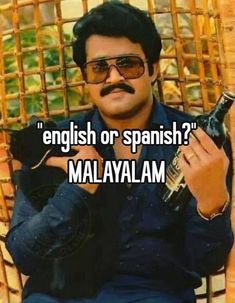
Being a Mallu

So? After a long pause, I begin, but where do I start? Those familiar with Kuttan from Bangalore Days might understand the long pause.


Recently, I heard someone remark that Kerala is divided into three parts: North, Central, and South, with a population of Muslims in the north, Christians in the center, and Hindus in the south, and that Malayalam unites them. (It’s crucial to acknowledge that this statement oversimplifies Kerala’s demographics. While there are regional concentrations of different religious communities, Kerala is known for its diverse and interwoven population, where religious communities are not neatly confined to specific geographical areas.)
Long pause, deep breath. This compels me to clarify the state of Kerala. A state with 600km of Arabian Sea shoreline, known for beaches, backwaters, mountains, spices, and much more. The etymology of the name Kerala is assumed to be from the Chera dynasty, “Land of Chera.” Some say it results from the nickname “land of coconuts” or even from Cheralam, meaning “declivity of a hill or a mountain slope.” The state was formed in 1956. Globally, we are known as “God’s Own Country.” Yes, we speak Malayalam, which has three major regional dialects with more than 20 sub-dialects.
WHAT?
Enth | Athu Entha | Enthuva | Enna | Enthutta | Yentheru

As a language, Malayalam has a tradition of borrowing from other languages, including Portuguese, Arabic, Tamil, and Sanskrit, due to trade and colonization. The current trend is the recontextualization of globalized English expressions into local cultural spaces, a result of the huge influence of cinema on Malayalis. In April 2024, the Malayalam film Aavesham exploded onto the silver screen, mesmerizing viewers with its witty and punchy one-liners. ‘Eda mone’ (hey, boy!) and ‘Rangamon happiyalle?’ (is Rangamon not happy?), some of its most iconic dialogues, captured the collective imagination of the Malayali psyche to such an extent that the crowd jovially embraces them even in formal conversations. This craze is not new; we Malayalis have always been movie buffs. We even speak Malayalam film as a language. This love for film dialogues naturally extends to our vibrant meme culture where film clips and characters are used to create social commentary that is shared world wide. It can be confidently stated that “no one can beat a Malayali when it comes to trolls and memes.” These are our ways of bringing humor to powerfully question politics, decorum, and the functions of the state. “What truly distinguishes Malayalis’ use of trolls and memes is the pivotal role of cinema. Specifically, comedy scenes and the expressive performances of comedic actors from films released in the 1980s and 1990s serve as the primary raw material for these digital creations. If a film genre holds universal appeal among Malayalis, it is undoubtedly comedy. While some may be unfamiliar with Elippathayam or Devasuram, it is hard to imagine a Malayali who doesn’t know Manichithrathazhu, Ramji Rao Speaking, and Kilukkam by heart. Malayalam comedy movies were the first to show caste discrimination with both humor and criticism, from the point of view of those facing it, and in a way everyone could understand. This connects these movies strongly to the social criticism we see in trolls. The movies used everyday logic to make social criticism and self-reflection accessible to everyone. Basically, they made cultural criticism, which was usually done by experts with complicated language, something anyone could do. As 90s kids, beyond the humor, we also remember what we referred to as Mammootty films, Mohanlal films, and Jayaram films, which portrayed macho heroes.  
Over time, Malayali film enthusiasts have moved from simply watching films and accepting characters to demanding logical and reasonable answers to their questions, marking the shift and ever-evolving nature of a Malayali.
Films from earlier decades are being reexamined and criticized for their treatment of the marginalized and their comments on individuals with disabilities. 22 Female Kottayam, released in 2012, has been appreciated for its different style of representation of women. New-generation Malayalam films, have a different pattern. At the same time I would also say though the new generation of Malayalam films is structurally better than their counterparts in the previous generation, notably for the inclusion and representation of the marginalized and women, patriarchal ideologies do creep into these structures in disguise. For example, even when a female character is shown as strong and independent, the story will often focus on her relationship with a male character. Also, it is the same Malayalam cinema industry that initiated conversations on the politics of cinema as an industry and a workplace and formulated WCC, as well as led to the Justice Hema Commission report.
And so, returning to that initial ‘So?’ This duality – the simultaneous presence of progressive ideals and subtle biases – demonstrates the capacity for critical engagement that defines Kerala society.Many of my non-Malayali friends have commented on the Mallu way of speaking. I have been on the receiving end of two comments:…”
1. You don’t look like a Mallu, you don’t sound like a Mallu. 2. You sound like a Mallu.
My answer to this is the recontextualized term ‘ayinu,’ which literally translates to “So what?”
Because being a Malayali isn’t about fitting someone else’s narrow definition. It’s about a spirit, a way of being. We’re a people who’ve always embraced diversity, absorbed influences, and made them our own. We’re proud of our rich culture, our language, our history – but we’re also open to the world. Maybe I don’t fit your stereotype, but that’s because we’re not a stereotype. We’re a vibrant, evolving community, spread across the globe. We carry our identity in our hearts, in our humor, in our love for food and cinema. We adapt, we innovate, but we never forget who we are.
So, after great consideration and consultation, I conclude that I’m a Malayali in my own way, and that’s something to be proud of. We all are.”

References

  1. Jenny. 2002. Reading Laughter: The Popular Malayalam ‘Comedy-Films’ of the Late 80s and Early 90s. Unpublished PhD Thesis. Hyderabad: Central Institute of English and Foreign Languages.
  2. https://alablog.in/issues/50/newness-of-new-generation-cinema/
  3. https://www.thehindu.com/archives/malayalam-dialects/article30405487.ece
  4. Report: Shift Focus: Women Shaping the Narrative in Media and Entertainment, Women in Cinema Collective and Sakhi Women’s Resource Centre.