I’m sure many of you rewatch movies, for all sorts of reasons. Maybe it’s to reconnect with a certain time in your life, for the fashion, or because you have a soft spot for the actress/actor. Maybe you admire the lifestyle depicted, or just want to revisit the humour after a rough day. If I ran a poll, the answers would go on and on.
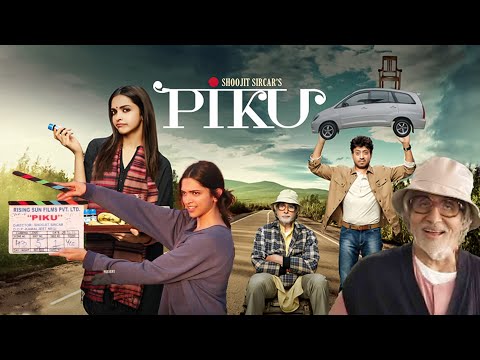
Piku is one such movie in my rewatch list. Watched, rewatched, re-rewatched, if that’s even a word (LOL). I’m not even sure it’s because she plays an architect. That would be the predictable assumption. Maybe on the first watch, yes, that drew me in. But that’s not why I keep returning to it.
The movie released on May 8, 2015. I didn’t catch it in theatres, just another hosteller watching a terrible-quality print much later. When it came on Apple TV, the choice was to rent or buy, and without thinking twice, I bought it. I wanted it with me, always. I’ve probably watched it over a hundred times by now. Most recently, I watched it on my 31st birthday, with two friends, in a slightly stinky theatre in Mysore. (Point being: the theatre may stink, but if it’s Piku, I’ll sit through it.)
The screening was part of the film’s 10th anniversary. Watching it on my birthday was a happy coincidence, was a cherry on top.
On one of his posts, Mr. Bachan says Piku is a “simple, elegant, elegiac tale of a hypochondriac, over-possessive father and his harassed, embittered daughter.” The film talks about bowel movements as if they’re the most exciting thing in life. It’s funny, but it’s also deep.
The emotions in Piku are raw and unapologetic. Quirky yet grounded in the sheer monotony of everyday life. The characters balance on the edge of eccentricity and boredom, and somehow find harmony in their dreadfully unexciting lives.
Have you ever had a tune stuck in your head for days?
A lot of you would agree with me, the music is just the best to your ears in this movie.
The film opens with the Sarod and Sitar, sounds almost forgotten now. There are no flashy visuals in the opening credits, just black background, white text, and the red dot on the “i” in Piku. It lets you focus on the music. The background score recurs, sometimes as an interlude, sometimes to underscore a particular emotion, and sometimes as the background score it is meant to be.
Apart from Anupam Roy’s compositions, there are three Bengali songs keeping up with the Bengali roots they come from.
1. ”Jeebone Ki Parbo Na” – sung by Manna Dey (1969) – plays after Bhashkor dances his heart out after a party.
2. ”Aei Poth Jodi Na Shesh Hoy” – from Saptapadi (1961), sung during the road trip to Kolkata. Bhaskor starts to sing and Piku adds to it, little off the pitch but a father daughter banter kinda moment. And he explains the meaning of the song to Rana (Irfan).
3. ”Pagla Khabi Ki” – from Open Tee Bioscope (2015), played during the impromptu dance session in the Kolkata house after Chhobi Mashi’s unannounced visit.
The Everyday Woman
Piku doesn’t chase drama. It sinks into the everyday.
Deepika Padukone’s Piku feels like a mix of many urban women: a single daughter, a caregiver, an architect, a working professional in a male-dominated field. She’s someone who owns her choices, She’s tired, quick to snap, caring but no-nonsense.
There’s a scene that lingers: Rana feels displaced in his own car because her father’s help, Budhon, has taken the front seat. Without a word, Piku slides in next to him. It’s not romantic. It’s recognition. That’s who she is, a woman who negotiates space not with rebellion, but quiet resolve.
The Architect in her
Piku being an architect isn’t a narrative crutch, but it shows in subtle ways. At one point, she asks Bhashkor to use a shade card to describe poop color. Who else but an architect would do that?
The first thing she does upon reaching their ancestral home, Champakunj, is feel the space. Classic architect instinct. Even the correction of spelling from “Bhaskar” to “Bhashkor” on the nameplate shows her rooted attention to detail.
Feminism Without a Banner
Piku isn’t a feminist film by declaration but by existence. It’s Bhashkor who voices the most progressive views; he scoffs at purposeless marriage and fiercely guards his daughter’s independence, though partly because it keeps her with him. Maybe Bhashkor’s dig about Syed having constipation was his way of rejecting him, not because of morality, but because he feared his daughter might give up her life for someone else’s care. He didn’t want her to become her mother.
When the Child Becomes the Parent
Bhashkor is 70 but acts like a child. His obsession with constipation isn’t really about digestion; it’s about control. He’s clingy, demanding, sometimes plain selfish. And Piku? She mothers him. She feeds him, checks his temperature, and gets up at night to give him his pills.
Their roles have quietly flipped. “Father hai, to tum unki maa kyun bani baithi ho?” Rana asks her. It’s not a question, it’s the truth, plain and blunt.
“Parents ko sambhalna padta hai… unhe zinda rakhna padta hai.”
She isn’t saying it with resentment. It’s not a martyr’s line. It’s just what she does. What many do. Because love, when aged, often looks like responsibility. And care, when unglamorous, is still care.
This is the real core of Piku. Not the road trip, not the romance, but this strange, heavy love between a daughter and her ageing father. It’s not dramatic or saintly. Just real. Exhausting, loyal, full of small, invisible acts of care. And in Rana, we find not a hero, but a mirror, someone who sees her without needing her to explain.
The details you can’t miss
You can almost smell the phenyl, the lunch cooking, the flowers wilting in brass vases. The large wooden bookcase in the CR Park home, the brass décor, lampshades that glow in nearly every room of the film, the portrait of a woman in Piku’s bedroom, vintage cutlery and white ceramics, the mirrors with patina. It all just adds to the memories the characters share and the realistic impact on the viewer.
Colour Red
Red appears quietly in the film, the title dot, the visuals, and the mood. It isn’t about passion or rage, as many associate with the colour. The movie does bring in the Bengali-ness of the film, the Tagore portraits, Ray references, and old songs. Maybe red adds to this aspect of the film too, but its subtle presence runs through the narrative.
Why Piku Stays With Me
Piku doesn’t pretend. That’s why it stays with me. She’s not perfect. She doesn’t fit into a “good girl” or “bad girl” box. She’s real. The film ends with a quiet moment of possibility.
Piku may or may not choose Rana. But the point is, she can. Not because something ended. Not because she broke free. But because things shifted.
“Compromise toh karna padta hai na life mein.” (Quoting Rana here). Maybe. But the best ones don’t erase you. They make space for you.
That’s why the movie is named after her.
Not Bhashkor. Not Rana.
Piku.
 The D.O.T