Not Bhashkor. Not Rana. Piku.

I’m sure many of you rewatch movies, for all sorts of reasons. Maybe it’s to reconnect with a certain time in your life, for the fashion, or because you have a soft spot for the actress/actor. Maybe you admire the lifestyle depicted, or just want to revisit the humour after a rough day. If I ran a poll, the answers would go on and on.

Piku is one such movie in my rewatch list. Watched, rewatched, re-rewatched, if that’s even a word (LOL). I’m not even sure it’s because she plays an architect. That would be the predictable assumption. Maybe on the first watch, yes, that drew me in. But that’s not why I keep returning to it.

The movie released on May 8, 2015. I didn’t catch it in theatres, just another hosteller watching a terrible-quality print much later. When it came on Apple TV, the choice was to rent or buy, and without thinking twice, I bought it. I wanted it with me, always. I’ve probably watched it over a hundred times by now. Most recently, I watched it on my 31st birthday, with two friends, in a slightly stinky theatre in Mysore. (Point being: the theatre may stink, but if it’s Piku, I’ll sit through it.)

The screening was part of the film’s 10th anniversary. Watching it on my birthday was a happy coincidence, was a cherry on top.

On one of his posts, Mr. Bachan says Piku is a “simple, elegant, elegiac tale of a hypochondriac, over-possessive father and his harassed, embittered daughter.” The film talks about bowel movements as if they’re the most exciting thing in life. It’s funny, but it’s also deep.

The emotions in Piku are raw and unapologetic. Quirky yet grounded in the sheer monotony of everyday life. The characters balance on the edge of eccentricity and boredom, and somehow find harmony in their dreadfully unexciting lives.

Have you ever had a tune stuck in your head for days?

A lot of you would agree with me, the music is just the best to your ears in this movie.
The film opens with the Sarod and Sitar, sounds almost forgotten now. There are no flashy visuals in the opening credits, just black background, white text, and the red dot on the “i” in Piku. It lets you focus on the music. The background score recurs, sometimes as an interlude, sometimes to underscore a particular emotion, and sometimes as the background score it is meant to be.

Apart from Anupam Roy’s compositions, there are three Bengali songs keeping up with the Bengali roots they come from.
1. ”Jeebone Ki Parbo Na” – sung by Manna Dey (1969) – plays after Bhashkor dances his heart out after a party.

2. ”Aei Poth Jodi Na Shesh Hoy” – from Saptapadi (1961), sung during the road trip to Kolkata. Bhaskor starts to sing and Piku adds to it, little off the pitch but a father daughter banter kinda moment. And he explains the meaning of the song to Rana (Irfan).

3. ”Pagla Khabi Ki” – from Open Tee Bioscope (2015), played during the impromptu dance session in the Kolkata house after Chhobi Mashi’s unannounced visit.

The Everyday Woman

Piku doesn’t chase drama. It sinks into the everyday.

Deepika Padukone’s Piku feels like a mix of many urban women: a single daughter, a caregiver, an architect, a working professional in a male-dominated field. She’s someone who owns her choices, She’s tired, quick to snap, caring but no-nonsense. 

There’s a scene that lingers: Rana feels displaced in his own car because her father’s help, Budhon, has taken the front seat. Without a word, Piku slides in next to him. It’s not romantic. It’s recognition. That’s who she is, a woman who negotiates space not with rebellion, but quiet resolve.

The Architect in her

Piku being an architect isn’t a narrative crutch, but it shows in subtle ways. At one point, she asks Bhashkor to use a shade card to describe poop color. Who else but an architect would do that?

The first thing she does upon reaching their ancestral home, Champakunj, is feel the space. Classic architect instinct. Even the correction of spelling from “Bhaskar” to “Bhashkor” on the nameplate shows her rooted attention to detail.

Feminism Without a Banner

Piku isn’t a feminist film by declaration but by existence. It’s Bhashkor who voices the most progressive views; he scoffs at purposeless marriage and fiercely guards his daughter’s independence, though partly because it keeps her with him. Maybe Bhashkor’s dig about Syed having constipation was his way of rejecting him, not because of morality, but because he feared his daughter might give up her life for someone else’s care. He didn’t want her to become her mother.

When the Child Becomes the Parent

Bhashkor is 70 but acts like a child. His obsession with constipation isn’t really about digestion; it’s about control. He’s clingy, demanding, sometimes plain selfish. And Piku? She mothers him. She feeds him, checks his temperature, and gets up at night to give him his pills.

Their roles have quietly flipped. “Father hai, to tum unki maa kyun bani baithi ho?” Rana asks her. It’s not a question, it’s the truth, plain and blunt.

“Parents ko sambhalna padta hai… unhe zinda rakhna padta hai.”

She isn’t saying it with resentment. It’s not a martyr’s line. It’s just what she does. What many do. Because love, when aged, often looks like responsibility. And care, when unglamorous, is still care.

This is the real core of Piku. Not the road trip, not the romance, but this strange, heavy love between a daughter and her ageing father. It’s not dramatic or saintly. Just real. Exhausting, loyal, full of small, invisible acts of care. And in Rana, we find not a hero, but a mirror, someone who sees her without needing her to explain.

The details you can’t miss 

You can almost smell the phenyl, the lunch cooking, the flowers wilting in brass vases. The large wooden bookcase in the CR Park home, the brass décor, lampshades that glow in nearly every room of the film, the portrait of a woman in Piku’s bedroom, vintage cutlery and white ceramics, the mirrors with patina. It all just adds to the memories the characters share and the realistic impact on the viewer.

Colour Red

Red appears quietly in the film, the title dot, the visuals, and the mood. It isn’t about passion or rage, as many associate with the colour. The movie does bring in the Bengali-ness of the film, the Tagore portraits, Ray references, and old songs. Maybe red adds to this aspect of the film too, but its subtle presence runs through the narrative.

Why Piku Stays With Me

Piku doesn’t pretend. That’s why it stays with me. She’s not perfect. She doesn’t fit into a “good girl” or “bad girl” box. She’s real. The film ends with a quiet moment of possibility.
Piku may or may not choose Rana. But the point is, she can. Not because something ended. Not because she broke free. But because things shifted.

“Compromise toh karna padta hai na life mein.” (Quoting Rana here). Maybe. But the best ones don’t erase you. They make space for you.

That’s why the movie is named after her.

Not Bhashkor. Not Rana.

Piku.

Not Rosy as You Think: The Myth & Reality of Being in Academics.

I started my career as an academician in 2019. A few said, “Wow… teaching is a great profession” (I don’t disagree). But when that statement is followed by, “Well, it’s good for a girl to be in academics rather than in practice”… mmm, that has annoyed me, then, now, and always, for several reasons.

Is that so?
Should the role of a teacher be assessed by gender?

That question itself could be a separate piece altogether. But what nudged me to finally write this one was an article I recently came across “I am Damned if I Do and Damned if I Don’t” by Dr. Anuradha Chatterjee, published in ThinkMatter. In reference to her insights and drawing from my own personal experiences, comes this piece.

I’ve heard, though I’m not sure of the source, that architecture as a course is increasingly perceived as a “feminine” profession, with the assumption that girls will be able to work from the office and also handle the home front.

It’s not just the assumptions from outside that sting; it’s what happens within the four walls of academia that often cuts deeper. Because here’s the twist: even within a supposedly progressive, intellectual space like an academic institution, the gendered lens doesn’t disappear. It morphs. It operates in subtle ways: in hallway conversations, performance appraisals, student feedback, and colleague comparisons.

Let’s not pretend it’s easy – we are constantly under scrutiny.

And this is where the illusion fades, and the reality begins.

There’s an unspoken bias: we prefer to be taught by a male faculty. (Why? How ironic, in comparison to the saying teaching is best suited for women.)
We want a senior faculty member to teach us. (Should we respond, “You’re too young to be even taught,” just to mirror the absurdity?)
There’s a pattern of applause, reserved for the male faculty whose lectures may have flair but may come peppered with factual errors. But never mind the errors; performance is the currency.

Diplomacy over reality and ethics wins. Play nice. Smile more. Be pleasant. Don’t rock the boat. Because if you do, if you dare to critique a student’s work with honesty and rigour, you’ll quickly learn: the fake consoling makes a faculty popular. The one who tells the hard truth? Inevitably, disliked.

And then there are others, those who seemingly support from the outside, but when it comes to action, their support quietly folds.

There are also those of any gender who say, “I’m on your side,” but it turns out their support isn’t about standing with you. It’s more about strategy. They quietly push you to take sides, plant doubts about others, and stir things up, while they stay in the background, looking neutral. In time, you realise it’s not really about fairness or doing what’s right. It’s about getting more attention, more fans, and playing quiet politics under the mask of being helpful.

And the double standard: when a student does well, it’s because of their brilliance and the institution’s quality. But if a batch performs poorly? That’s on you, the faculty. No matter the hours, the guidance, the effort, it evaporates under a wave of blame.

In many ways, it reminds me of Mona Lisa Smile. Katherine Watson walks into a prestigious women’s college, not to reinforce convention but to challenge it. Her role as an art history professor becomes a mirror of how academia often boxes women, expecting them to inspire, but not challenge; to teach, but not disrupt; to nurture, but not confront. The moment she pushes the students to think beyond the curriculum, she is seen as radical. Unsettling. Difficult.
Isn’t that familiar?

When I first started teaching, I remember asking my mentor, “Why do you think I should teach? And why me?”
He replied, “You might not know everything, and you may not change the whole class. But maybe, just maybe, you’ll bring about a behavioural change in one student.”
I’ve held on to that. I still believe it.

But now, after six years, I find myself circling back to that question: was my decision right?

Some days, I’m not so sure.

And yet, in the middle of all the noise, the doubt, and the exhaustion, there are quiet reminders. A random message from an old student saying, “I was just thinking about that lecture,” or someone showing up, unannounced, just to catch up, not out of obligation, but out of connection. No big gestures, just small moments that say, “You mattered.”

Maybe that’s where the answer lies.
Maybe there is still hope.
But maybe… It’s also okay to say: I need a break.

Not to quit. Just to pause. To breathe.

“Do me a favour, do yourselves a favour. Stop talking, and look”

Once

Being a Mallu

So? After a long pause, I begin, but where do I start? Those familiar with Kuttan from Bangalore Days might understand the long pause.


Recently, I heard someone remark that Kerala is divided into three parts: North, Central, and South, with a population of Muslims in the north, Christians in the center, and Hindus in the south, and that Malayalam unites them. (It’s crucial to acknowledge that this statement oversimplifies Kerala’s demographics. While there are regional concentrations of different religious communities, Kerala is known for its diverse and interwoven population, where religious communities are not neatly confined to specific geographical areas.)
Long pause, deep breath. This compels me to clarify the state of Kerala. A state with 600km of Arabian Sea shoreline, known for beaches, backwaters, mountains, spices, and much more. The etymology of the name Kerala is assumed to be from the Chera dynasty, “Land of Chera.” Some say it results from the nickname “land of coconuts” or even from Cheralam, meaning “declivity of a hill or a mountain slope.” The state was formed in 1956. Globally, we are known as “God’s Own Country.” Yes, we speak Malayalam, which has three major regional dialects with more than 20 sub-dialects.
WHAT?
Enth | Athu Entha | Enthuva | Enna | Enthutta | Yentheru

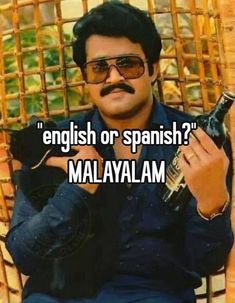
As a language, Malayalam has a tradition of borrowing from other languages, including Portuguese, Arabic, Tamil, and Sanskrit, due to trade and colonization. The current trend is the recontextualization of globalized English expressions into local cultural spaces, a result of the huge influence of cinema on Malayalis. In April 2024, the Malayalam film Aavesham exploded onto the silver screen, mesmerizing viewers with its witty and punchy one-liners. ‘Eda mone’ (hey, boy!) and ‘Rangamon happiyalle?’ (is Rangamon not happy?), some of its most iconic dialogues, captured the collective imagination of the Malayali psyche to such an extent that the crowd jovially embraces them even in formal conversations. This craze is not new; we Malayalis have always been movie buffs. We even speak Malayalam film as a language. This love for film dialogues naturally extends to our vibrant meme culture where film clips and characters are used to create social commentary that is shared world wide. It can be confidently stated that “no one can beat a Malayali when it comes to trolls and memes.” These are our ways of bringing humor to powerfully question politics, decorum, and the functions of the state. “What truly distinguishes Malayalis’ use of trolls and memes is the pivotal role of cinema. Specifically, comedy scenes and the expressive performances of comedic actors from films released in the 1980s and 1990s serve as the primary raw material for these digital creations. If a film genre holds universal appeal among Malayalis, it is undoubtedly comedy. While some may be unfamiliar with Elippathayam or Devasuram, it is hard to imagine a Malayali who doesn’t know Manichithrathazhu, Ramji Rao Speaking, and Kilukkam by heart. Malayalam comedy movies were the first to show caste discrimination with both humor and criticism, from the point of view of those facing it, and in a way everyone could understand. This connects these movies strongly to the social criticism we see in trolls. The movies used everyday logic to make social criticism and self-reflection accessible to everyone. Basically, they made cultural criticism, which was usually done by experts with complicated language, something anyone could do. As 90s kids, beyond the humor, we also remember what we referred to as Mammootty films, Mohanlal films, and Jayaram films, which portrayed macho heroes.  
Over time, Malayali film enthusiasts have moved from simply watching films and accepting characters to demanding logical and reasonable answers to their questions, marking the shift and ever-evolving nature of a Malayali.
Films from earlier decades are being reexamined and criticized for their treatment of the marginalized and their comments on individuals with disabilities. 22 Female Kottayam, released in 2012, has been appreciated for its different style of representation of women. New-generation Malayalam films, have a different pattern. At the same time I would also say though the new generation of Malayalam films is structurally better than their counterparts in the previous generation, notably for the inclusion and representation of the marginalized and women, patriarchal ideologies do creep into these structures in disguise. For example, even when a female character is shown as strong and independent, the story will often focus on her relationship with a male character. Also, it is the same Malayalam cinema industry that initiated conversations on the politics of cinema as an industry and a workplace and formulated WCC, as well as led to the Justice Hema Commission report.
And so, returning to that initial ‘So?’ This duality – the simultaneous presence of progressive ideals and subtle biases – demonstrates the capacity for critical engagement that defines Kerala society.Many of my non-Malayali friends have commented on the Mallu way of speaking. I have been on the receiving end of two comments:…”
1. You don’t look like a Mallu, you don’t sound like a Mallu. 2. You sound like a Mallu.
My answer to this is the recontextualized term ‘ayinu,’ which literally translates to “So what?”
Because being a Malayali isn’t about fitting someone else’s narrow definition. It’s about a spirit, a way of being. We’re a people who’ve always embraced diversity, absorbed influences, and made them our own. We’re proud of our rich culture, our language, our history – but we’re also open to the world. Maybe I don’t fit your stereotype, but that’s because we’re not a stereotype. We’re a vibrant, evolving community, spread across the globe. We carry our identity in our hearts, in our humor, in our love for food and cinema. We adapt, we innovate, but we never forget who we are.
So, after great consideration and consultation, I conclude that I’m a Malayali in my own way, and that’s something to be proud of. We all are.”

References

  1. Jenny. 2002. Reading Laughter: The Popular Malayalam ‘Comedy-Films’ of the Late 80s and Early 90s. Unpublished PhD Thesis. Hyderabad: Central Institute of English and Foreign Languages.
  2. https://alablog.in/issues/50/newness-of-new-generation-cinema/
  3. https://www.thehindu.com/archives/malayalam-dialects/article30405487.ece
  4. Report: Shift Focus: Women Shaping the Narrative in Media and Entertainment, Women in Cinema Collective and Sakhi Women’s Resource Centre.

1-15 = Inhale, Exhale, Core Engage!

16th August 2024 marks a year since I moved to Mysore. Reflecting on the past year, I realize I’ve had some intriguing experiences and changes. Since relocating to Mysore, I’ve been aiming to improve my lifestyle but lacked the necessary motivation. However, in July 2024, during our college vacation, I found myself pondering how to spend those five days.

Fitness has always been a challenge for me—I just don’t see myself fitting into that world. In June, I visited my friend, who is a fitness enthusiast. Her husband, on the other hand, has always leaned towards junk food like I do. To my surprise, he had recently joined a gym and was both regular and enthusiastic about it. This was a sign.

When I was considering my vacation plans, I talked to a close friend who advised, “Keep yourself healthy, join a gym, and I’ll track whether you follow through!” That was a serious conversation, and it hit me hard. The next day, when my parents visited, they echoed the same advice: “Stay fit.”

So, what did I decide?

We took a drive to explore our options, and I recalled my colleague mentioning her positive experience with Pilates. I had never engaged in any structured workout before—walking occasionally was the extent of my activity. I shared the details of the Pilates studio recommended by my colleague and decided to visit it with my parents. I signed up for a trial session, which led to a month-long commitment. I had no idea what to expect, but I was genuinely impressed by the space and the overall layout of the studio.

After my trial session, I called my parents and told them, “I didn’t realize that breathing in and out could be so challenging, but I’ll keep trying.”

Kudos to Jini and Adheera for their rigorous effort in training and to Shanthi Ma’am, a fellow member, whose consistency inspires me. Who would have thought that counting from 1 to 15 could make you break a sweat? A month has passed, and I’m enjoying the sessions at Jini’s Pilates Studio. Looking back on my first year in Mysore, I’m really happy with the decision to start this training. This one month of Pilates has become a constant reminder of the importance of strengthening my core and muscles.

Thanks to my friends and family for their encouragement. As they say, “Consistency is everything… you’ll be able to do it.”

Is it the Place or People?

I have been trying to put together this piece for a while, and it looks like now is the time. Where do I start? Probably with a question: Which is your favorite city? Isn’t that a bit general? Let me rephrase: Which city out of the ones you have lived in stands out on your list? I have my answers but am still on a quest for the reasons.

I grew up until I was six in Adoor at my mom’s residence. Am I fond of this place? Not the place as a whole, but I am in love with the memories associated with it—from my grandma’s kitchen to my grandpa’s clinic, from our red-colored gate to Ravathar’s Kada (shop), on the way the smell of rubber sheets from Baby Uncle’s house, wishing to stop at the ice factory for some sip-up (only possible if my cousin Mittu was around), the flowers we collected to take to church, walking through the rubber plantations, where my grandpa would securely hold my wrist and say “Priya kutta sookshich” (Be careful, “kutta” is an affectionate way of addressing a dear one), the excitement of going with Amma to Chandras Tailors and Lissy Aunty’s shop for buying clothes, holding hands and walking with my grandparents to Shobas, walking with my cousin Melvin through the alleys of the ice factory (in fact, the shortcut to reach the Milma store next to the market), where the shop owner would ask “Doctored e Kochumol ano?” (Are you the granddaughter of Doctor Mathukutty?). These are just a few examples, but I can say it is the presence of my grandparents and the memories around them that make the place stay in my heart. I have very little association with my Appa’s hometown (Padalam); however, I have several specific memories there too (the Kottanikal Veedu)—memories primarily associated with smells and some spatially, from the smell of chikku and lavalolika, the darkness of the nadumuri (room in the center), the unused courtyard, the smell of the wood, and of course, the Royal Enfield that was parked inside the house (as my dad was abroad).

I moved to Kozhikode/Calicut afterward. I still haven’t developed a deep fondness for the place; maybe my sister can relate to it more. However, again, my memories are revolving around people and, of course, our house “Kerith,” which we built in 2010.

The next city, Thiruvananthapuram (Trivandrum), now holds a special place in my heart. I spent 8 years living in this city. My fondness for this place seems to be a hereditary transfer; my dad also spent nearly 9 years here and had a similar affection. My first solo travel after graduating from school was to Trivandrum. I then began my 5 years of Architecture studies at the College of Architecture Trivandrum. Over those five years, every nook and corner of Trivandrum became familiar, and I would still love to continue learning and unlearning about this place. In the early days of my stay in Trivandrum, I used to go to Bakery Junction just to have the cold coffee from Ambrosia, then come to Statue Junction and walk to my aunt’s house (Ammachi’s house). Later, I started to explore the city by walking from Palayam to Eastfort, and Eastfort to Thycaud. I never had any particular hangout spot with my friends, but the MG Road stretch was something we all loved hanging out on. After completing my bachelor’s, I decided to apply for a master’s immediately and got into the College of Engineering Trivandrum (CET). This part of the city then became a fondness for me, with the mixed crowd at Sreekaryam stretch, the endless queue at Pradeepettan’s print shop, the political banners around, and the strong coffee with my friends after college. Trivandrum became even more memorable with additions like charcoal shawarma, Paul’s Creamery, movie nights, and drives filled with nonstop talking with “Bayya” (who could be considered my local guardian). There is not a single time I had to leave Trivandrum without him safely dropping me at the bus stand or railway station. Towards the end of my Master’s course, I received a call from JK Sir to be part of CAT, which was my bonus to stay in Trivandrum again. I continued staying in Endura (6H), where I met my dearest Asha. We bonded over “F.R.I.E.N.D.S”; she is a vegetarian, and I’m a pure non-vegetarian, but we explored every possible cuisine. However, Fab Cafe and Cafe Mojo remained our favorites. The place becomes even closer to your heart because of the memories created with these people, adding color because a few of my friends from my master’s program stayed back in Trivandrum.

Sometimes I wonder, why do you feel safe in a city? Is it the city itself or the presence of a dear friend? For me, apart from my family, there are people whose presence made me stay back, come back, and love a city. During the COVID period, like many others, I had to move back to my hometown, which turned out to be some of my best days in Kozhikode. In 2021, I moved to Bangalore (“Bangalore, what a rocking city yaar” – as said by DQ in Bangalore Days). The city is not unfamiliar but still new to me. I was initially stuck and clueless, but over time, I overcame this cluelessness. Being away from home and living alone, it was important for me to feel safe. The presence of my very close friend Vinay in the city made it easier for me. I often told him, “Dude, it’s just a sense of you being somewhere in the city that makes me feel safe.” This could be due to the childhood familiarity and bond we share. However, my friend circle grew, and I began to love not just Bangalore but “Ka-Manhattan” (Kamanhalli), for once again, the people. But here’s the challenge: Do I love Ka-Manhattan for the people or the place? Are my memories dear because of C-260, 302, or E-618? Definitely, yes, but for the first time, a place also felt like a companion. I used to take walks along CMR Road, stop by Paperback, the bookstore, and simply walk around the street just to embrace some joy. At this point, I even started to enjoy the traffic. For me, if Trivandrum moulded me, Bangalore helped me evolve. However, the journey doesn’t stop; I moved to Mysore in 2023.

What does this city have to offer me now? I did not come for the love of the city but for my work. The only familiarity is “Annachi,” who makes the city interesting for me. But this city is making me ponder a lot. After my shift, I was gifted the book Lonely City by Olivia Laing by my friend Priya (in fact, we picked this book together, but she didn’t give it to me at that point, as she wasn’t sure if the book would be a good companion because I was unsettled in Mysore). Later, she gifted the book to me in December 2023. Strangely, the book started to reflect my write-up during the COVID days (a few months I was lonely in Bangalore). I haven’t found a fondness yet, but there are acquired familiarities, with CCBC being one. I mostly visit CCBC every morning for dosa and chutney, and the daily encounters with people there make us smile at each other. It has reached a point where they know my order without me asking. Corner House is slowly becoming a place of interest, and my newfound liking for vada pav at Mumbai Chai and Snack (ironically in Mysore) is another development. The city is also giving me time to consider movies as a companion (playing over and over a few of my favorites), bringing back my old playlist, and watching certain series I watched a long time ago, trying to understand why I watched them then and why I watch them now. The city is making me realize the importance of many dearly loved ones. Life in the city is also awakened due to some very long phone conversations I’ve had with a few of my friends (which is unusual for me).

What do I look forward to in this city? Is it still a “stranger in the city” moment, or have I settled? One thing I know is that the presence of certain people makes a place likable and gives you a sense of comfort. There are a few who are making me like this city as well (in fact, I shared this with a dear friend today). However, I feel a city becomes a place of fondness when it accepts you, embraces you—not just the people but a sense the city gives you to let yourself be. I’m still in search of that missing puzzle in the jigsaw.

Why do you connect to certain cities and not to others? Is it the people you associate with, or is there a certain quality the place offers? Is it the smell or color? Is it the smiles and chats? Is it the big alphabets and noisy posters? Is it the music and cuisine? Is it just a particular old bookstore? Is it your childhood?

Why do you remember the details of a place?

I am writing this probably because of my curiosity in searching for the meaning of “place.” I hope to figure it out in the coming months and continue this write-up.

Master of Disguise

In a world of pretension and concealing,

Everything seems identical.

The streets are filled with similar gaze,

People moving in and camouflaging,

Nurtured in the art of insistent lies,

Paving a web of words that is hollow.

Is survival the reason?

Is it fear of acceptance?

Where do I stand?

Unfinished Portrait

The unfinished portrait

Left incomplete, kept aside for another time

Who would finish those strokes

Who would add hue to the empty pallet

Would it be the sparkle in her eyes or sorrow in her

Would it be her radiant glow or a frowning face

Awaiting the day when the render stands completed